What Is Central Entity in SEO?
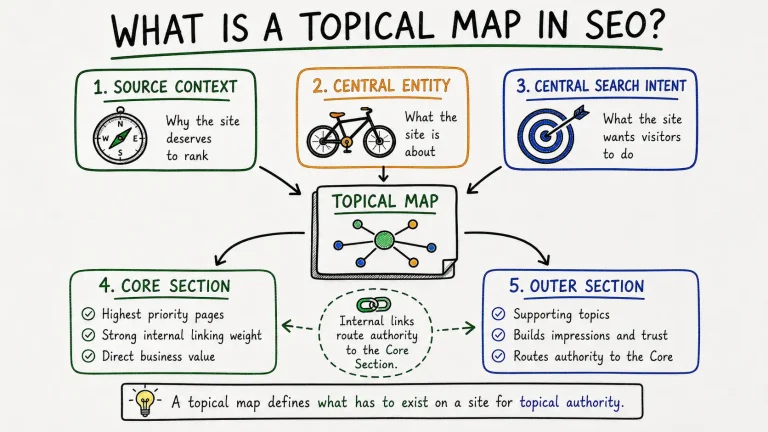
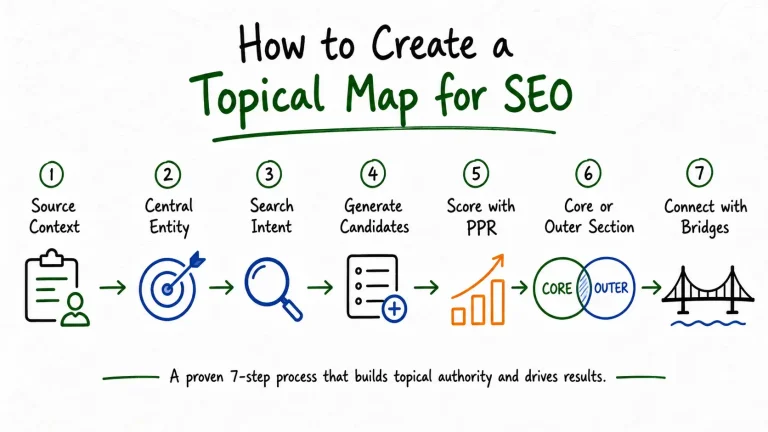
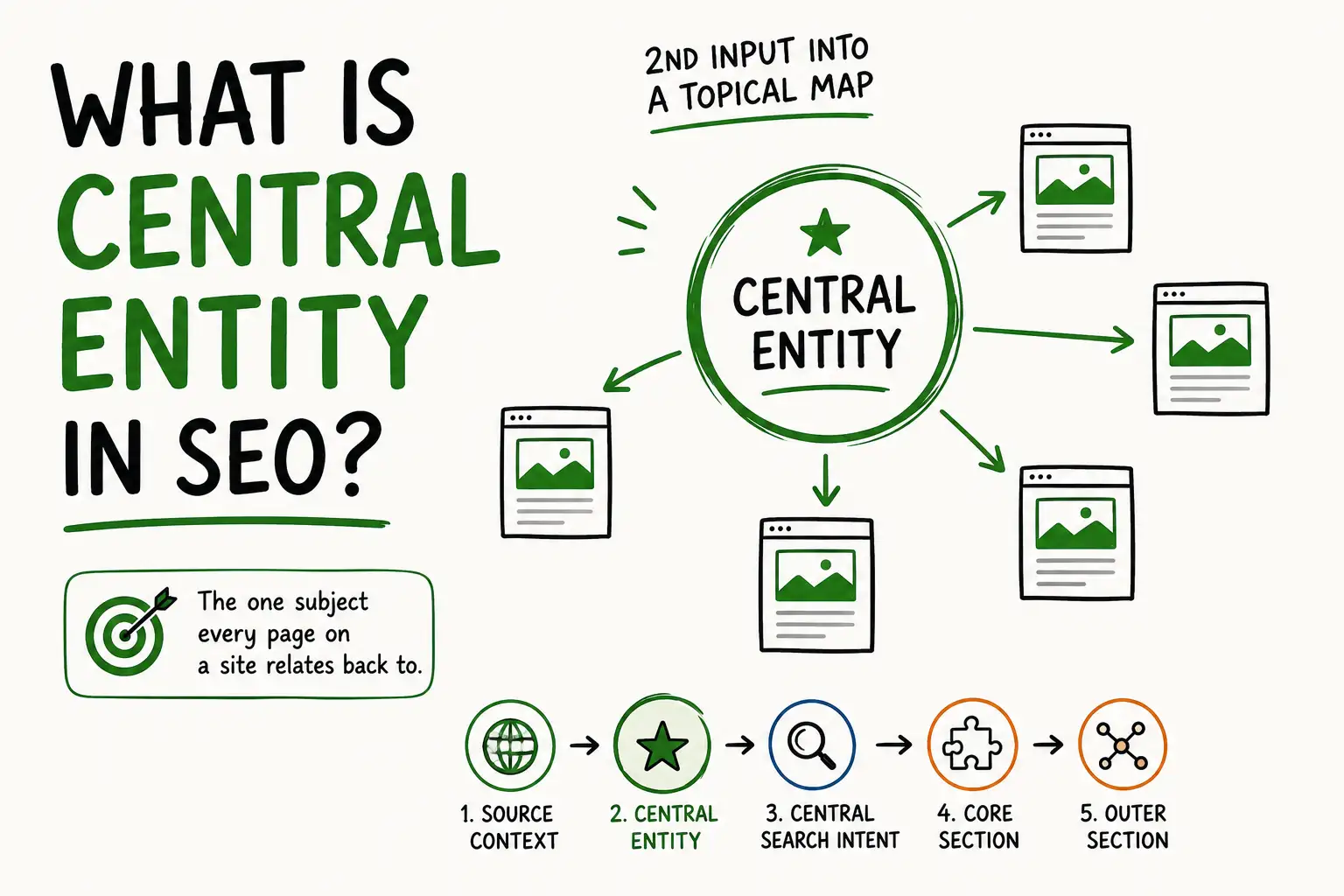
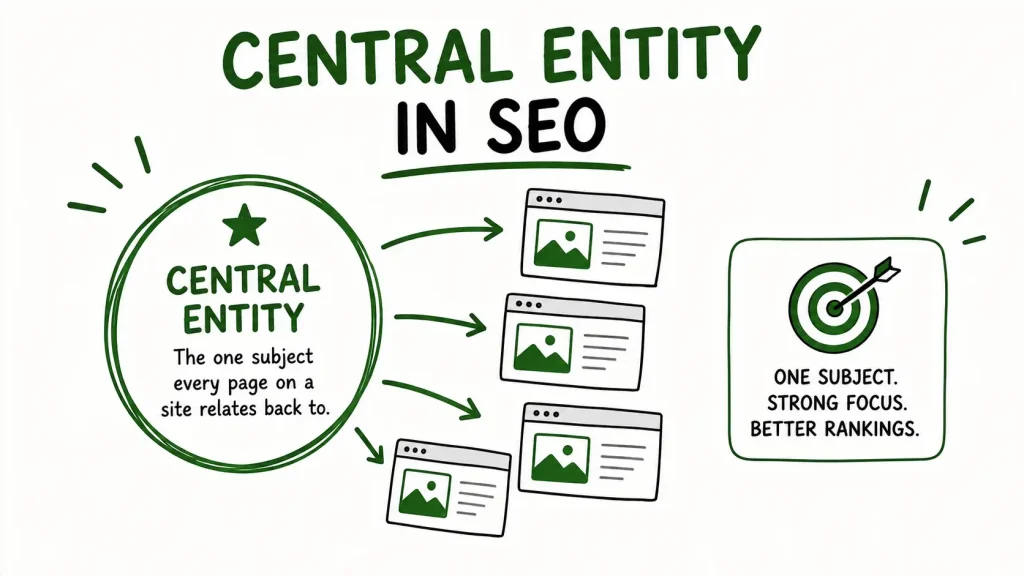
Central Entity is the single subject that every page on a website relates back to, chosen deliberately as part of building a topical map, alongside Source Context and Central Search Intent. It’s the second of the 5 inputs required to build a topical map. A site can publish hundreds of pages and still maintain one Central Entity, as long as each page connects to it through a defined attribute or relationship.
Central Entity: Semantic SEO Strategy vs. General Information Retrieval
“Central entity” has two related but distinct meanings, and mixing them up causes real confusion. In general information retrieval, a central entity is whatever a search system algorithmically detects as the dominant subject of a single document or query, using entity graph centrality, weighted occurrence, and knowledge base matching. It’s a property a system extracts after the fact.
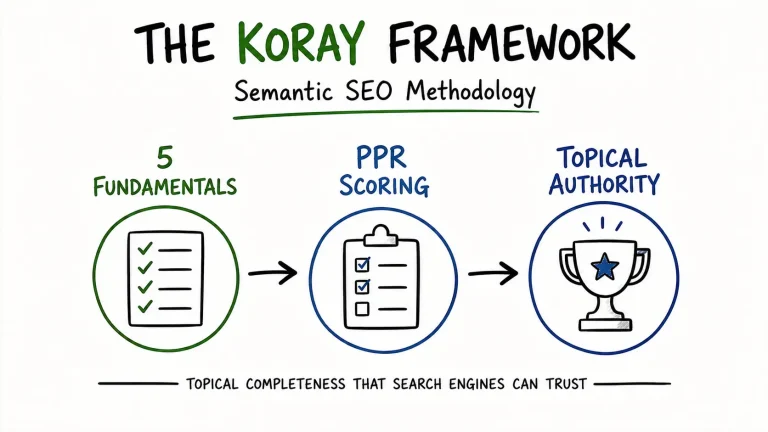
In Semantic SEO, and specifically in Koray Tuğberk GÜBÜR’s topical map framework, Central Entity means something more deliberate: the one subject a practitioner chooses in advance for an entire website, before a single page gets published. It’s not detected, it’s decided, and every subsequent input, Central Search Intent, the Core Section, the Outer Section, gets built around that decision.
The two senses connect in a useful way. Once a Central Entity has been deliberately chosen for a site, the individual pages on that site should each produce a strong, unambiguous central entity signal when analyzed by the general IR sense, the two mechanisms reinforce each other when the site is built correctly. That connection is the subject of the next section.
What Entity Salience Reveals About Central Entity
Once a Central Entity has been deliberately chosen for a site, the general IR sense of the term becomes the test that confirms whether the choice was implemented correctly. Google’s Cloud Natural Language API assigns every entity it detects in a piece of content an entity salience score, a number between 0 and 1.0 that measures how central that entity is to the content’s overall meaning. A score of 1.0 means the entity is the primary subject of the page.
This is directly testable. Submit any page’s text to the Google Cloud Natural Language API, and it returns every entity found, along with a salience score for each one. A page correctly built around a site’s chosen Central Entity produces one entity with a dominant salience score and several supporting entities with lower scores. A page that has drifted from the site’s Central Entity, or a site where the Central Entity was never clearly decided in the first place, often produces two or three entities competing for the top score, none of them dominant, which tells Google the page doesn’t have a clear subject.
This is the practical confirmation of what the strategic decision is supposed to produce. Choosing a Central Entity in the topical map framework only matters if it actually shows up as measurable entity dominance once the content is published, and entity salience is the direct way to check that.
The mechanism extends to the resource level, not just individual pages. Google’s own patents on identifying topical entities, including US Patent 10,068,022, “Identifying Topical Entities,” and US Patent 9,009,192, “Identifying Central Entities,” describe a related process: comparing search result overlap across candidate entities and using a centrality score to determine which entity a given resource is actually about. Both the patent language and the publicly available salience scoring point to the same underlying reality: search systems are built to identify one dominant subject per resource, not several competing ones, and a site with a clearly chosen and consistently reinforced Central Entity gives that identification process exactly what it’s looking for.
Central Entity Example
For an electric bike retailer, the Central Entity is electric bikes. Every page on the site, from battery range comparisons to local riding law guides, connects back to that single subject through a defined attribute or relationship. A page about battery range connects through the attribute “range.” A page about riding laws connects through the attribute “legal use.” Neither page is about something else, both are about electric bikes, viewed through a different attribute.
This is different from a site that simply mentions electric bikes frequently without a deliberate Central Entity decision behind it. A site that publishes broadly about cycling, outdoor gear, and general transportation, with electric bikes as one topic among several, produces exactly the kind of competing-entity signal described in the previous section: no single dominant subject, several entities each capturing partial relevance, and a weaker basis for topical authority on any one of them.
What Happens When a Site Has No Clear Central Entity
Without a deliberately chosen Central Entity, a site has no consistent standard to test new topics against, and no way to guarantee that individual pages reinforce each other’s entity salience instead of diluting it. Two symptoms show up reliably. First, the site’s pages compete with each other for algorithmic centrality instead of reinforcing one shared subject, the exact failure mode the entity salience test in the previous section is built to catch. Second, Central Search Intent can’t be defined correctly, because Central Search Intent is the unification of Source Context with Central Entity, and that unification has nothing stable to combine with Source Context if the Central Entity keeps shifting from page to page.
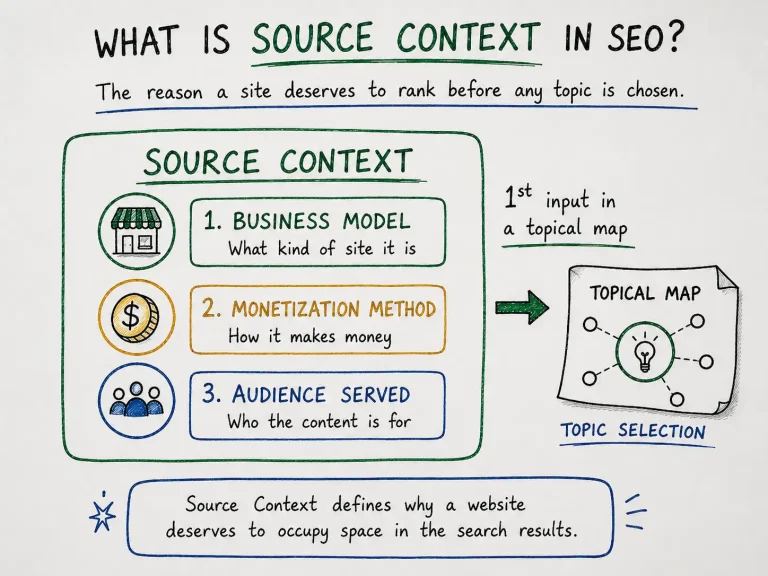
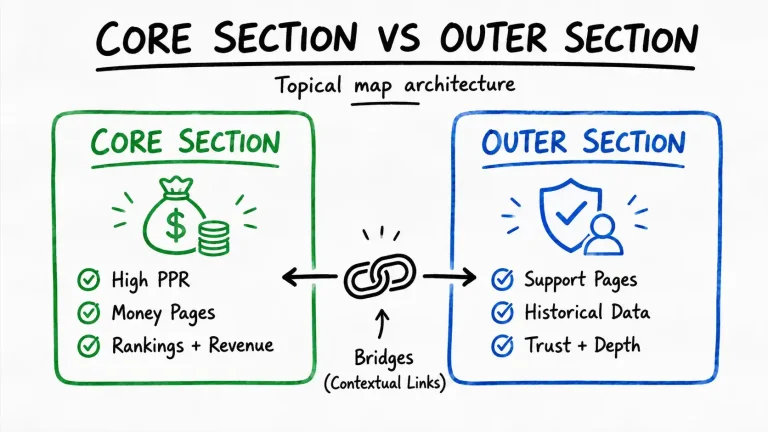
This is why Central Entity is defined second in the sequence, immediately after Source Context. Every input that follows it, Central Search Intent, Core Section placement, Outer Section placement, depends on Central Entity being fixed and consistent before those decisions get made.
Build a Topical Map With Central Entity Defined Correctly
Every topical map built at TopicalMap.Services starts with a deliberately chosen Central Entity, tested against Source Context before Central Search Intent gets defined, and validated against entity salience once content is published. If you want a map built this way for your own site, see the full topical map service for pricing and deliverables.
Contact Us TodayFrequently Asked Questions
Is Central Entity the same as a keyword?
No. A keyword is a search term. Central Entity is the underlying subject a site is organized around, one Central Entity can be described by dozens or hundreds of different keywords across different pages, all connecting back to the same subject.
Can a site have more than one Central Entity?
Not within the same topical map. A site trying to anchor two genuinely separate Central Entities usually produces the competing-entity signal described earlier, weaker salience for both, rather than strong authority for either. Two distinct entities generally need two separate topical maps.
How is Central Entity different from Central Search Intent?
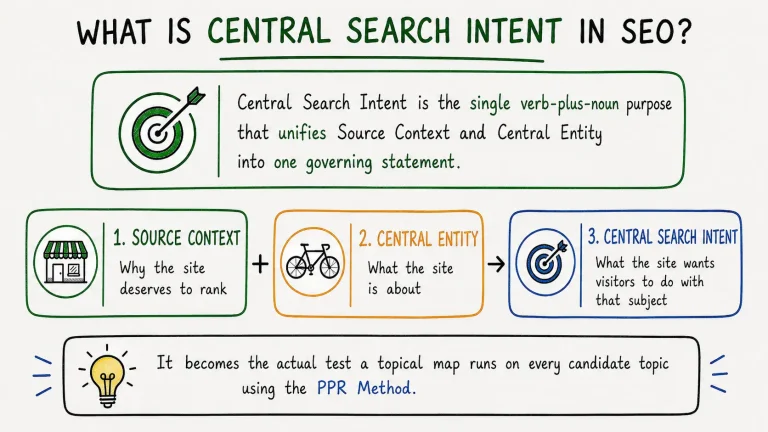
Central Entity answers what a site is about. Central Search Intent answers what the site wants visitors to do with that subject, and it’s built by combining Central Entity with Source Context. Central Entity has to be defined first.
Can I test whether my site’s Central Entity is clear?
Yes. Submit a page’s text to the Google Cloud Natural Language API and review the entity salience scores it returns. A page with a clear, correctly implemented Central Entity should show one entity with a dominant score, not several entities competing near the top.