What Is Central Search Intent in SEO?
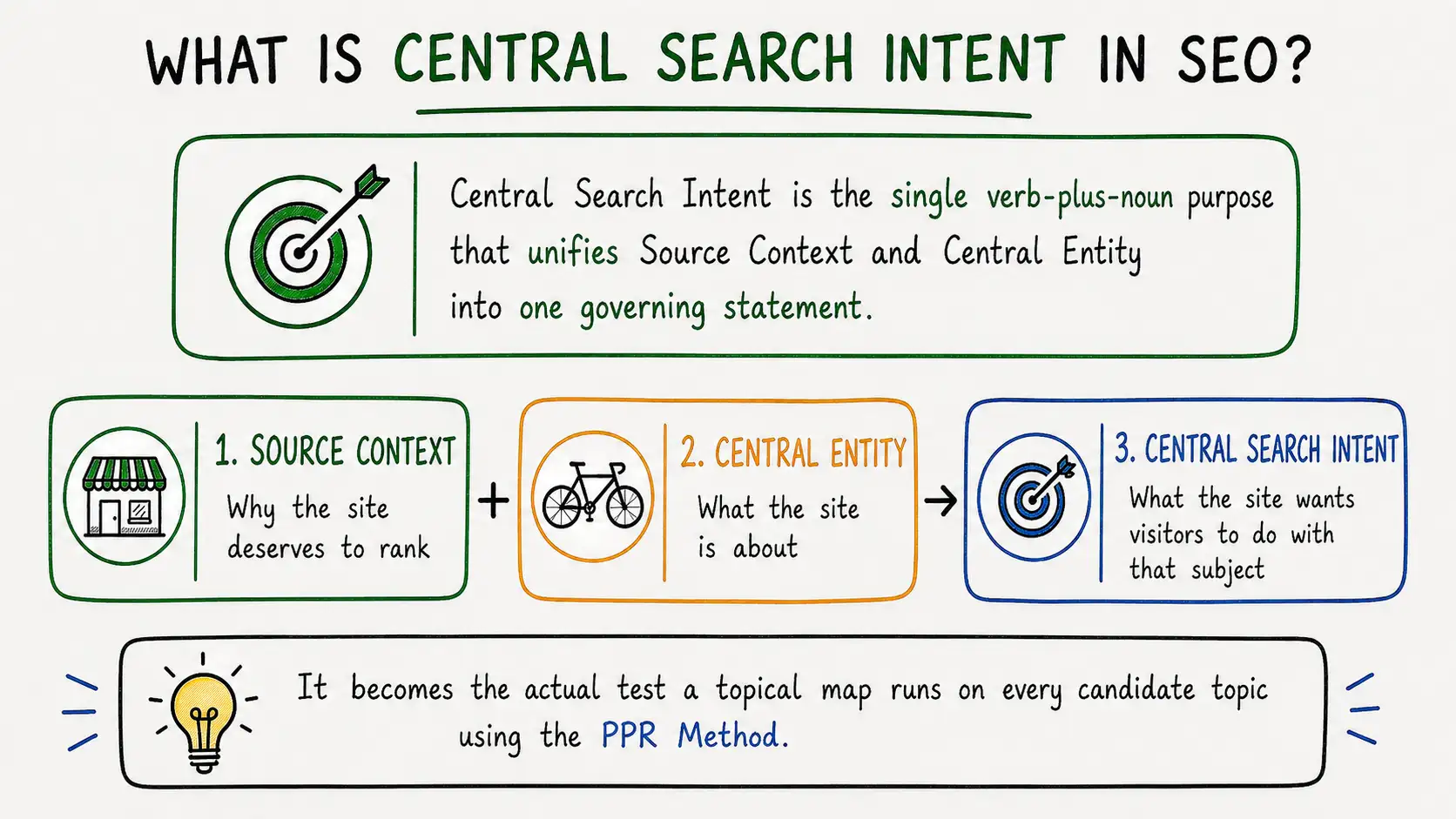
Central Search Intent is the single verb-plus-noun purpose that unifies Source Context and Central Entity into one governing statement, and it is what every topic on a topical map ultimately gets measured against. Source Context and Central Entity are inputs. Central Search Intent is what those two inputs produce, and once it’s defined, it becomes the actual test a topical map runs on every candidate topic, not Source Context or Central Entity individually.
Where Central Search Intent Fits in the Sequence
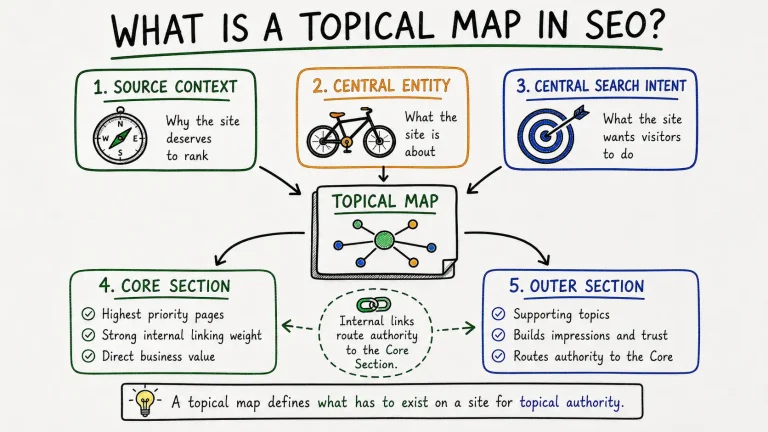
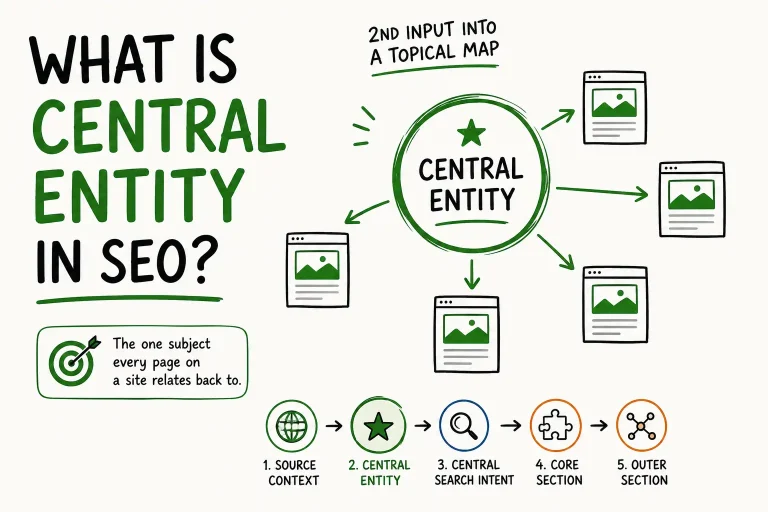
Central Search Intent comes third in the 5 inputs that build a topical map, after Source Context and Central Entity are both defined, and before any topic gets sorted into the Core Section or Outer Section. It can’t be defined first, because it’s a product of the two inputs before it, not a starting point of its own.
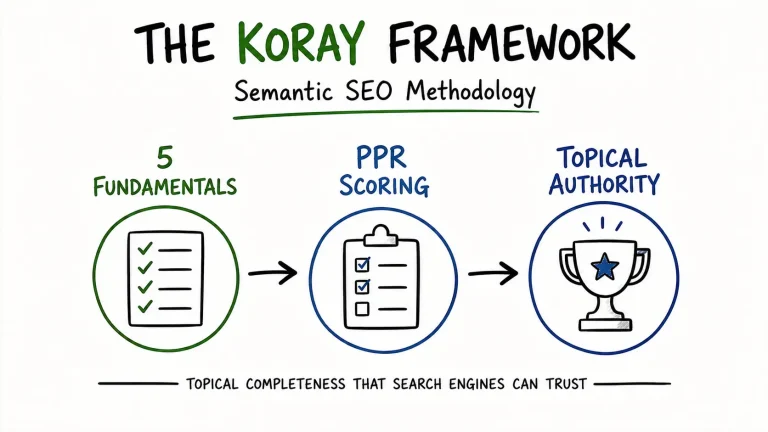
This is the piece that makes a topical map function as one connected system instead of two separate ideas sitting next to each other. Source Context explains why a site deserves to rank. Central Entity explains what the site is about. Neither one, on its own, tells you what to do with a candidate topic. Central Search Intent is what does that. Every topic scored later in the process, using PPR, gets tested against this one governing statement.
How Source Context and Central Entity Combine Into One Intent
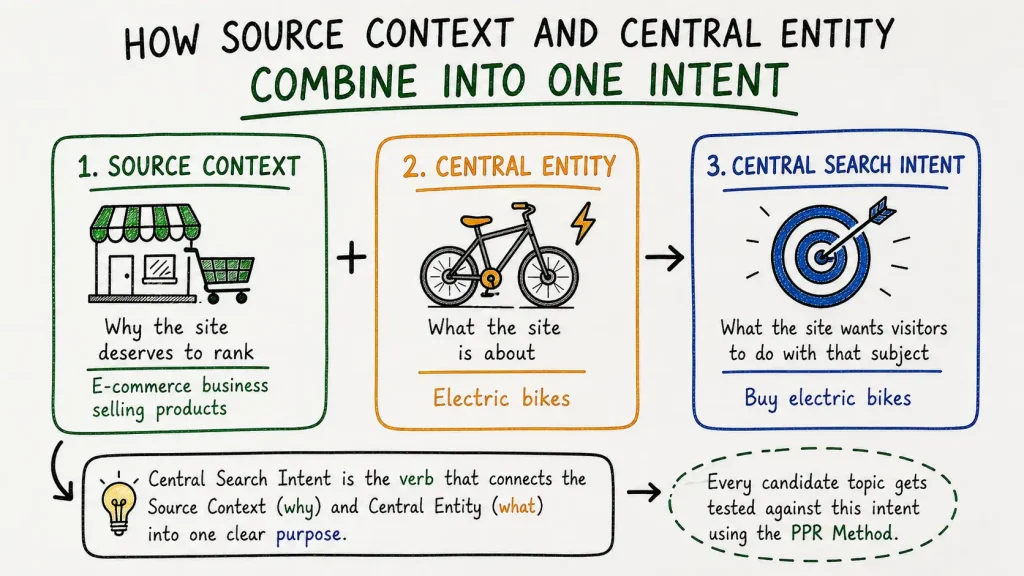
Combining the two isn’t a mechanical merge of two labels. It’s writing one sentence that captures what the site wants a visitor to do with its Central Entity, given why the site exists in the first place. Central Entity supplies the noun. Source Context supplies the reason that noun matters commercially. Central Search Intent is the verb that connects them.
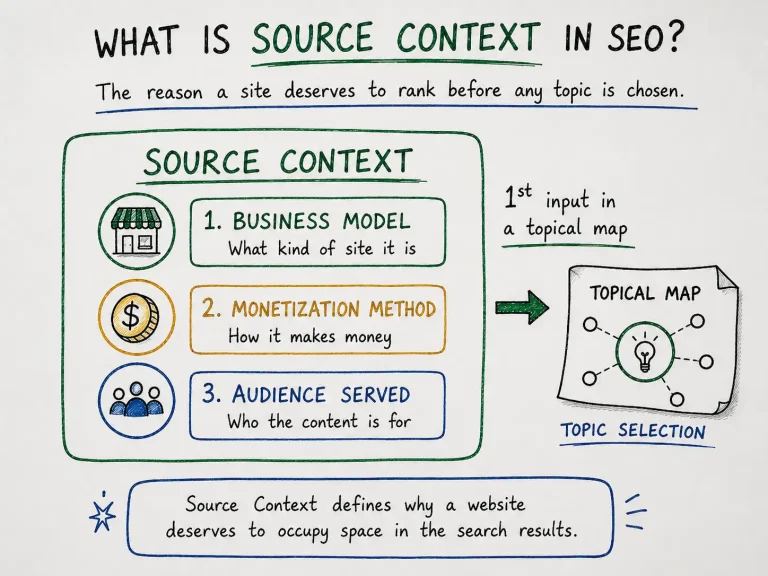
Source Context answers why a site deserves to rank, its business model and monetization method.
Central Entity answers what the site is about, the one subject every page relates back to.
Central Search Intent answers what the site wants visitors to do with that subject, given that business model.
Central Search Intent Example
For an electric bike retailer: Source Context is an e-commerce business monetizing through direct product sales. Central Entity is electric bikes. Combined, the Central Search Intent is buy electric bikes. Not “learn about electric bikes.” Not “electric bikes.” The verb matters as much as the noun, because it’s the verb that determines what kind of content earns a place on the Core Section versus the Outer Section.
A publisher covering the same Central Entity, electric bikes, with a Source Context built on advertising revenue instead of product sales, would produce a completely different Central Search Intent, something closer to understand electric bikes, and that single difference reshapes the entire topical map, even though the Central Entity never changed.
Why the Obvious Interpretation Is Sometimes Too Narrow
The first version of a Central Search Intent is rarely the final one. Koray Tuğberk GÜBÜR has described this using a coffee example: the obvious interpretation of intent for a coffee brand might look like “buy coffee beans,” but the real intent a site needs to serve is often broader, something closer to exploring coffee to build knowledge, refine taste, and improve brewing skill. The narrow version captures a transaction. The broader version captures why someone becomes a repeat visitor instead of a one-time buyer.
We run this check on every client project before finalizing a Central Search Intent. The test is simple: does this statement only describe the transaction, or does it describe the full reason someone engages with the site over time? A SaaS project management tool with a narrow Central Search Intent of “buy project management software” will build a topical map focused entirely on comparison and pricing content. Widen it to “evaluate and adopt project management software,” and the map naturally expands to include onboarding content, workflow guidance, and team adoption topics, all of which still serve the same Source Context and Central Entity, just with a governing intent that matches the real scope of what visitors need.
Getting this too broad causes its own problem, a Central Search Intent so wide it stops filtering anything out. The correction isn’t to make it broad by default. It’s to check whether the first, most obvious phrasing accidentally narrowed the intent down to a single transaction when the site’s actual Source Context supports something wider.
Build a Topical Map With Central Search Intent Defined Correctly
Every topical map built at TopicalMap.Services tests this statement before a single topic gets scored, narrow enough to filter out irrelevant content, wide enough to capture the site’s full commercial scope. If you want a map built this way for your own site, see the full topical map service for pricing and deliverables.
Contact Us TodayFrequently Asked Questions
Is Central Search Intent the same as user intent?
Not exactly. User intent usually describes what one person wants from one search query. Central Search Intent describes the single governing purpose for an entire site, the intent every page and every topic gets tested against, not just one query.
Can a site have more than one Central Search Intent?
No, not in the same topical map. A site with two genuinely separate governing intents, two different Source Contexts serving two different audiences, usually needs two separate topical maps, not one map trying to serve both.
What happens if Central Search Intent is defined too narrowly?
The topical map ends up thin. Topics that would build genuine authority get excluded because they don’t fit a transaction-only intent, even though they serve the same Source Context and Central Entity. This is the mistake we check for using the coffee example above.
Does Central Search Intent ever need to be revisited?
Yes, whenever Source Context or Central Entity changes. If a business shifts its monetization method or expands into a new product category, the Central Search Intent built from the old inputs no longer governs the site correctly.