What Is a Topical Map in SEO? The Complete Guide
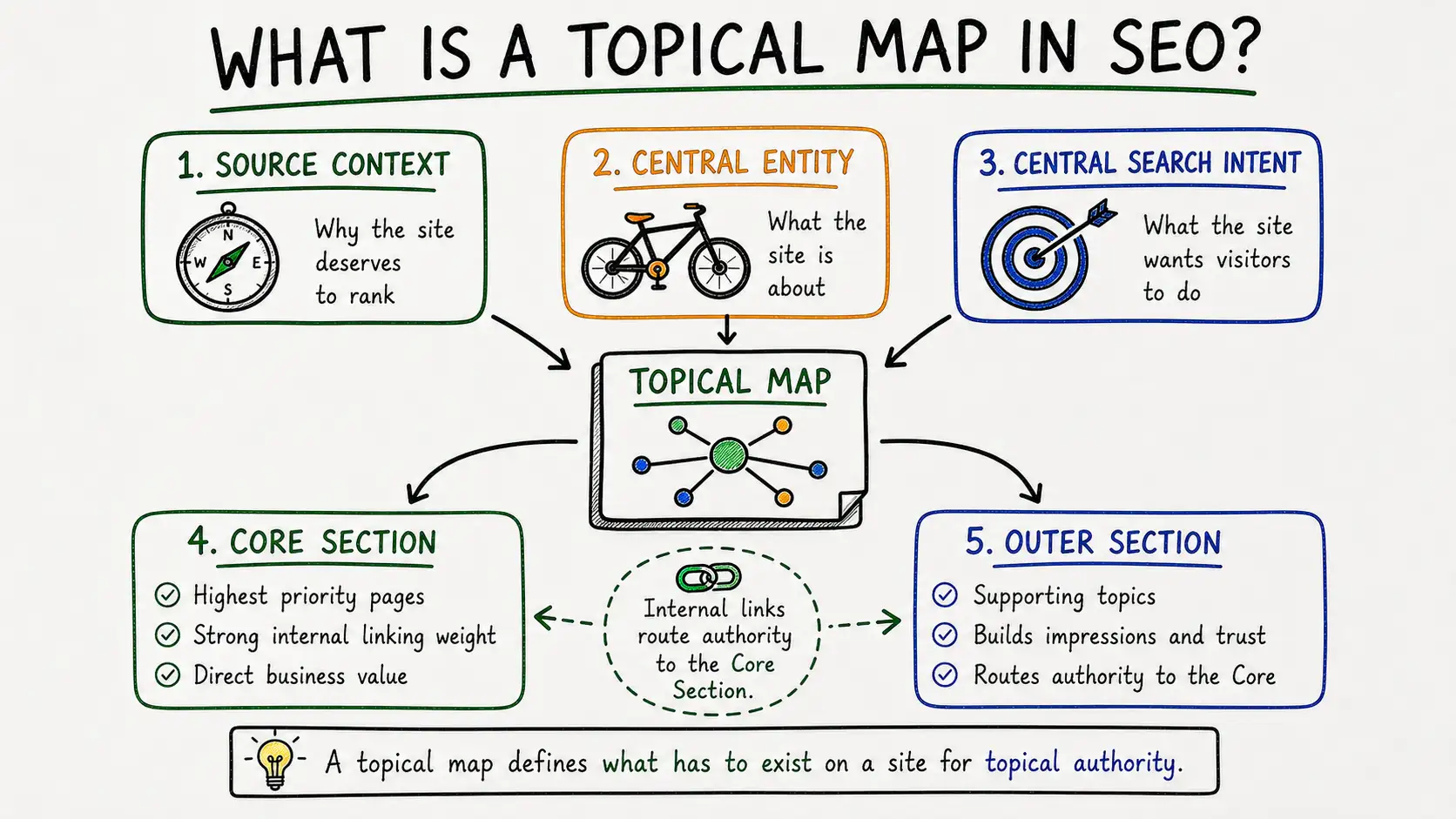
A topical map is a structured semantic framework that defines every topic a website must cover, how those topics connect to each other, and which section of the site each topic belongs to, built from three inputs: Source Context, Central Entity, and Central Search Intent. It is not a list of blog post ideas. It is the architecture that determines whether a site is eligible for topical authority in the first place.
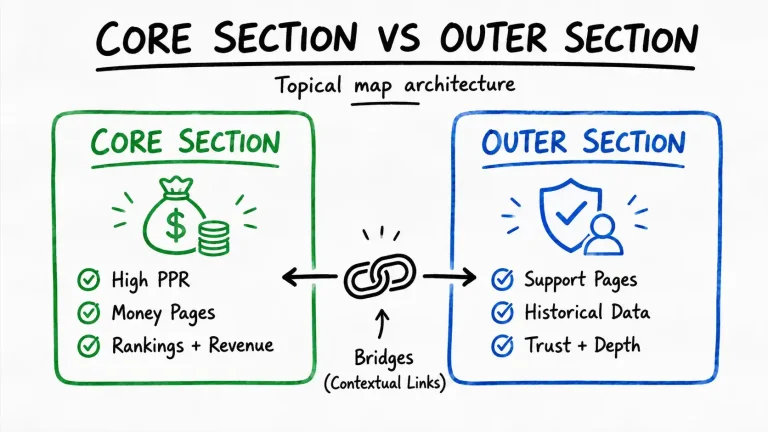
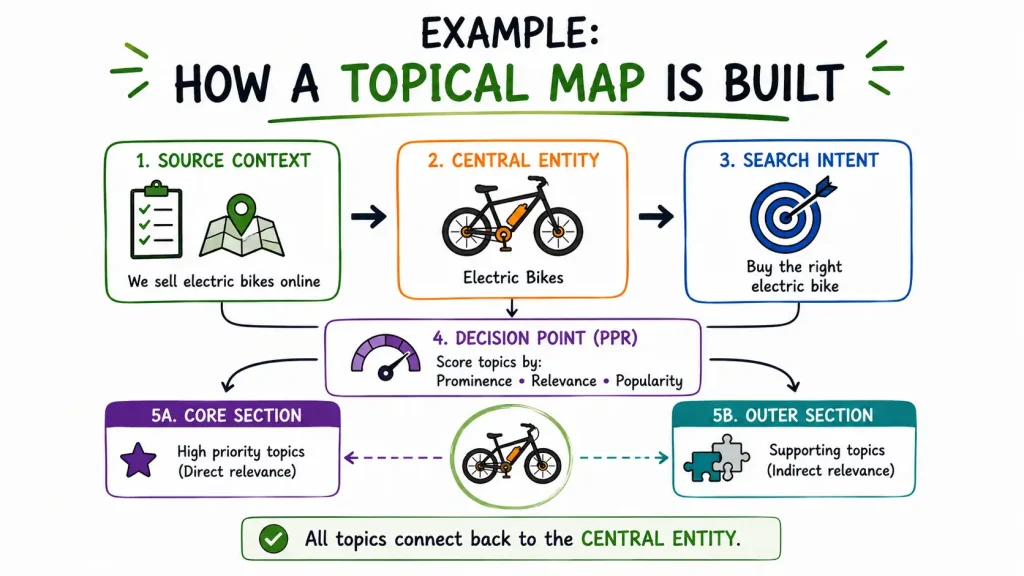
Every topical map divides its topics into two sections. The Core Section holds the topics with the highest Prominence and Relevance to the site’s Source Context, and carries the majority of the site’s monetization and internal linking weight. The Outer Section holds supporting topics that build historical data, in the form of impressions and clicks, and route authority back to the Core Section through internal links.
A topical map answers one question before any content gets written: what has to exist on this site for Google to recognize it as the best answer for this subject? Random publishing cannot answer that question. A structured map can.
The 5 Components Every Topical Map Must Have
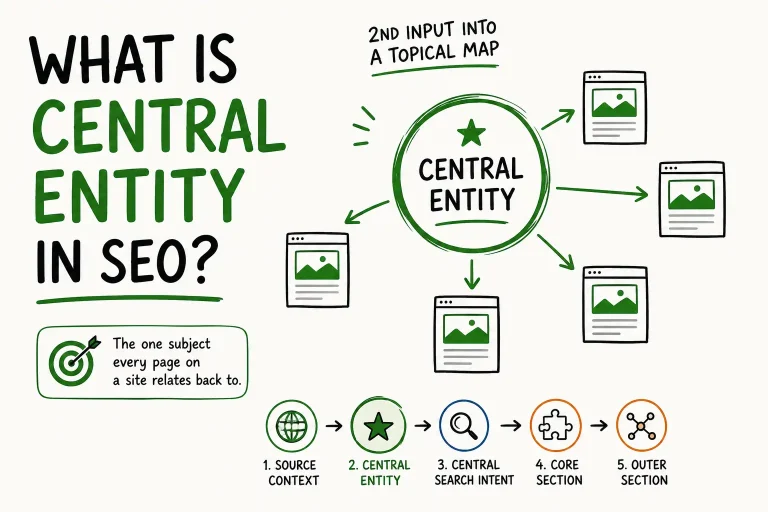
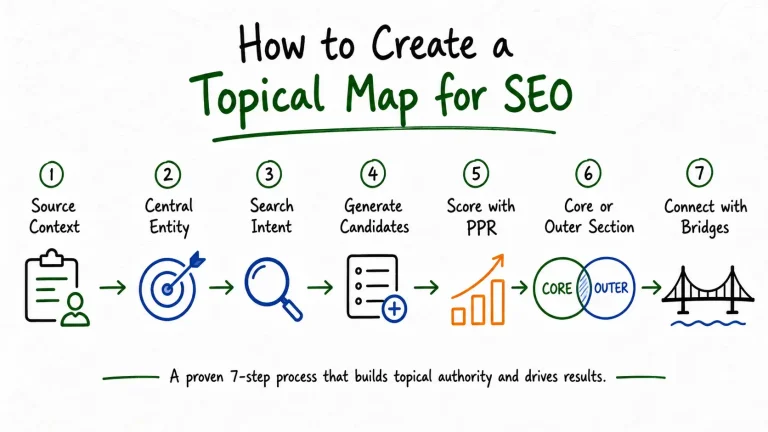
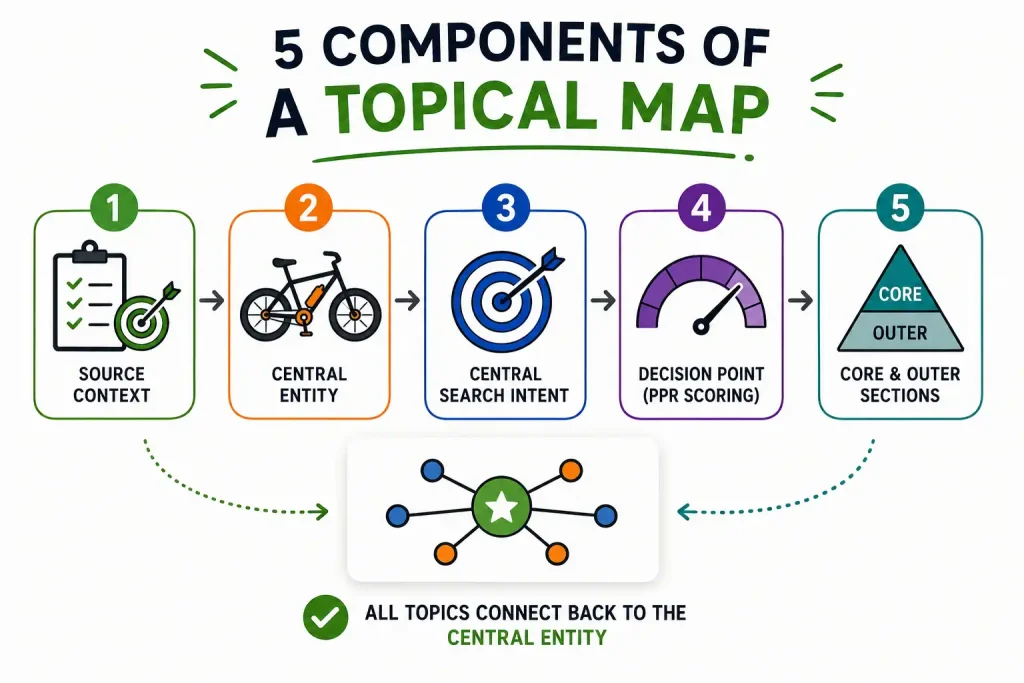
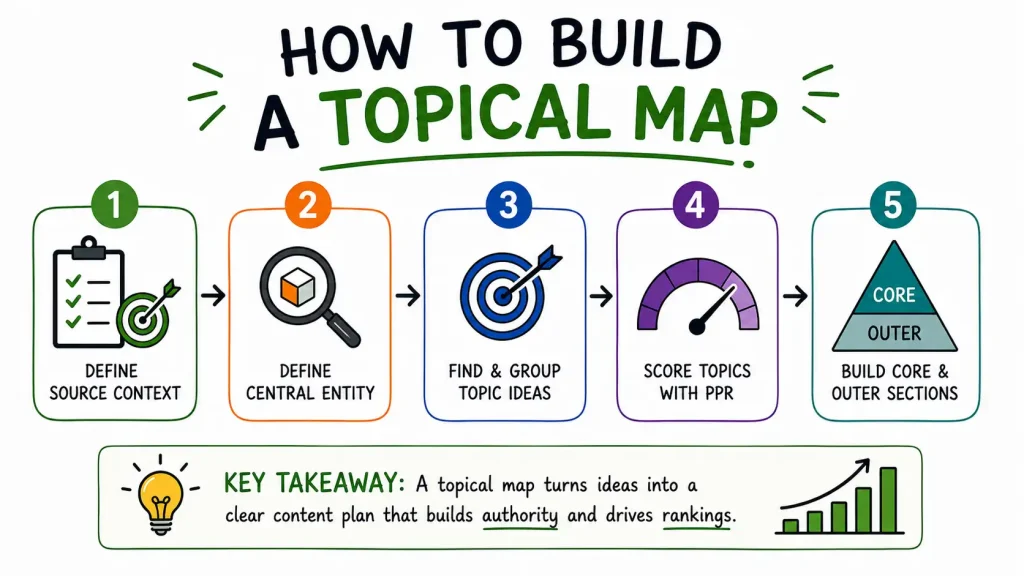
Every topical map is built from 5 components, and skipping any one of them produces a document that looks structured but functions as a keyword list. These 5 components work in sequence: the first 3 define the site’s purpose, and the last 2 define where each topic lives once that purpose is set.
Source Context: Why the Site Deserves to Exist in the SERP
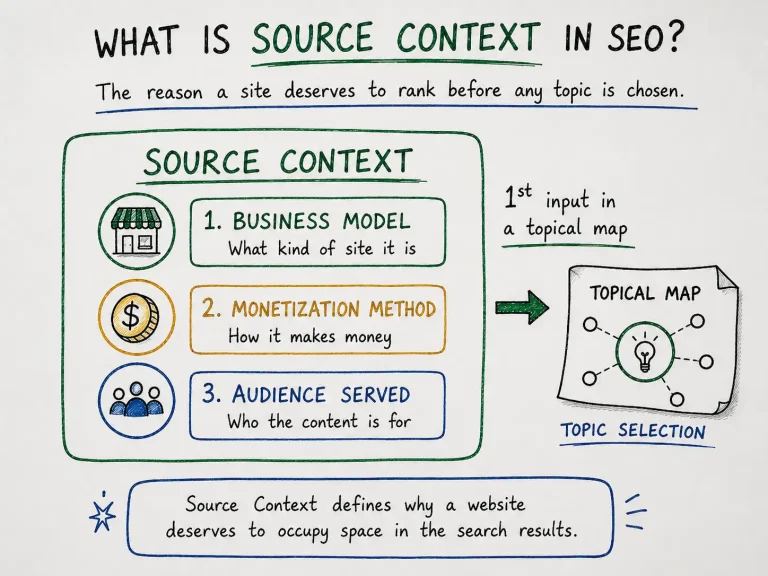
Source Context is the reason a website deserves to occupy space in the search results, defined by its business model, its monetization method, and the audience it serves. A site without a defined Source Context cannot filter which topics belong on it, because there is no standard to filter against.
An e-commerce store selling electric bikes monetizes through direct product sales, so its Source Context centers on purchase-decision content: comparisons, buying guides, and specifications. A topical map consultancy monetizes through service fees, so its Source Context centers on demonstrating methodology: framework explanations, worked examples, and case studies.
Central Entity: The One Thing the Whole Site Is About
The Central Entity is the single subject that every page on the site relates back to, even when individual pages cover different subtopics. A site can publish hundreds of pages and still maintain one Central Entity, as long as each page connects to it through a defined attribute or relationship.
For the electric bike retailer, the Central Entity is electric bikes. For a topical map service, the Central Entity is the topical map itself. Every page, from a blog post about battery range to a page about PPR scoring, must trace back to that one entity.
Central Search Intent: Where Source Context Meets Central Entity
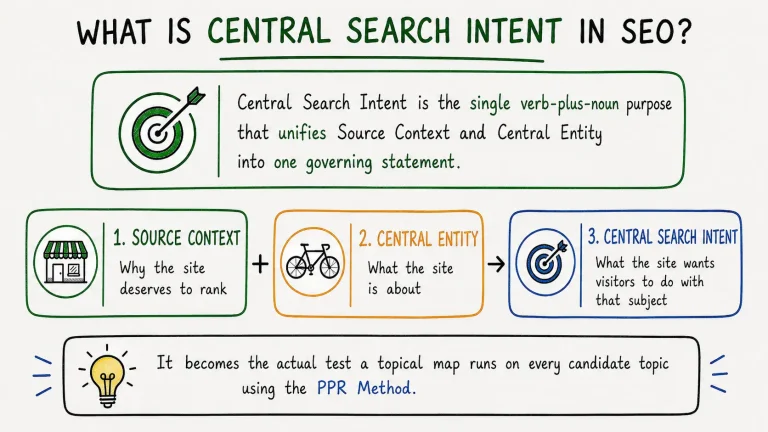
Central Search Intent is the single verb-plus-noun combination that unifies Source Context and Central Entity into one governing purpose for the site. It answers what the site wants a visitor to do with the Central Entity, not just what the Central Entity is.
For the electric bike retailer, Central Search Intent is buy electric bikes. For a topical map service, Central Search Intent is build topical authority. Every topic considered for the map gets tested against this intent before it earns a place on the site.
Core Section: Where Monetization and Authority Concentrate
The Core Section holds every topic scored highest for Prominence and Relevance to the Source Context, and carries the majority of the site’s internal linking weight and monetization pages. These are the pages Google is meant to rank first, and the pages every other page on the site should link toward.
For the electric bike retailer, the Core Section includes category pages, model comparison pages, and buying guides. For a topical map service, the Core Section includes the service pages themselves.
Outer Section: Where Historical Data and Trust Compound
The Outer Section holds supporting topics that build historical data, in the form of search impressions and clicks, and route authority back to the Core Section through internal links. These pages rarely convert directly. Their job is to widen the site’s footprint in the SERP and prove topical depth to search engines over time.
For the electric bike retailer, the Outer Section includes maintenance guides, battery care articles, and local riding law explainers. For a topical map service, the Outer Section includes definitional and educational content like this article.
Quick Reference: The 5 Components
| Component | Defines | Example (Electric Bike Retailer) |
|---|---|---|
| Source Context | Why the site deserves to rank | Monetizes via direct product sales |
| Central Entity | The one subject every page relates to | Electric bikes |
| Central Search Intent | Source Context + Central Entity, unified | Buy electric bikes |
| Core Section | Highest Prominence + Relevance topics | Category pages, model comparisons |
| Outer Section | Supporting topics, historical data | Maintenance guides, local riding laws |
Once these 5 components are defined, every candidate topic can be tested against them. The next section shows exactly how that test works, using a full worked example.
A Real Topical Map Example (Worked Walkthrough)
A topical map turns theory into a decision by scoring every candidate topic against the site’s Source Context, then sorting the winners into the Core Section or the Outer Section. The walkthrough below uses an electric bike retailer to show exactly how that scoring works, from a raw topic idea to a placed, justified position on the map.
Source Context: An online retailer selling electric bikes direct to consumers, monetizing through product sales and affiliate commissions on accessories.
Central Entity: Electric bikes.
Central Search Intent: Buy electric bikes.
With those 3 inputs set, 5 candidate topics get tested. Each one receives a Prominence score, a Relevance score, and a Popularity score, all on a 0–10 scale, then a final PPR score using the formula covered in the next section.
Worked Example: 5 Candidate Topics Scored and Placed
| Topic Title | Prominence | Relevance | Popularity | PPR Score / Decision |
|---|---|---|---|---|
| Best Electric Bikes for Commuting | 9 | 10 | 8 | 9.2 — Core. Highest scorer, direct purchase intent |
| Electric Bike Battery Range Comparison | 8 | 9 | 7 | 8.2 — Core. Core buying-decision attribute |
| How to Charge an Electric Bike Battery | 5 | 7 | 6 | 6.0 — Outer. Post-purchase support, builds historical data |
| Electric Bike Laws by State | 4 | 6 | 5 | 5.0 — Outer. Compliance concern, moderate relevance |
| Electric Bike vs Regular Bike: Calories Burned | 2 | 3 | 9 | 3.8 — Rejected. High demand, low relevance to Source Context |
The fifth topic is the one most content plans get wrong. Calorie comparisons between electric bikes and regular bikes carry real search volume, a Popularity score of 9 in this example, which makes the topic look attractive in a keyword tool. Its Relevance score is 3, because a retailer selling electric bikes has no commercial reason to build authority on general fitness content. Its PPR score of 3.8 falls below the inclusion threshold, so the topic gets rejected rather than published as a standalone page.
This is the PPR method’s core function: it keeps high-Prominence, high-Relevance topics on the map even when their search volume is modest, and it rejects high-Popularity topics when they carry no relevance to the site’s Source Context. A keyword list alone cannot make that distinction, because a keyword list has no Source Context to measure relevance against.
The next section breaks down exactly how the PPR formula produces these scores, so the same scoring method can be applied to any topic on any site.
How PPR Scoring Decides What Belongs in a Topical Map
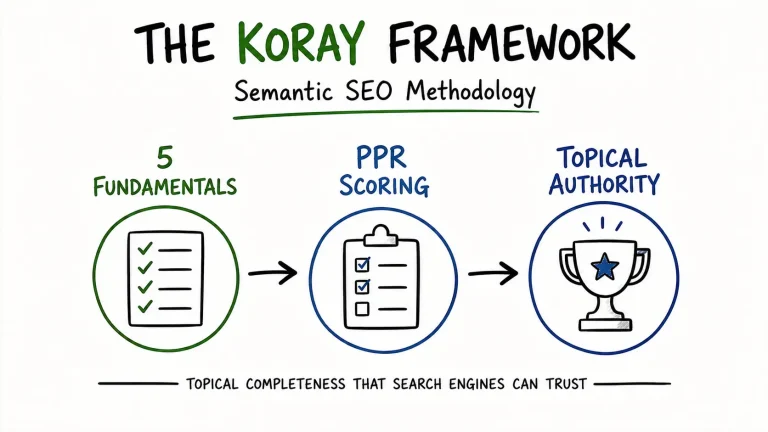
PPR stands for Prominence, Popularity, and Relevance, the 3 attributes used to score every candidate topic before it earns a place on a topical map, combined using a weighted formula that favors topical fit over search volume alone. This is the filtration step that turns a raw list of ideas into a justified map.
Each attribute measures something different:
Prominence measures how essential a topic is to defining the Central Entity. A topic with high Prominence is one a user would expect to find on any authoritative site about that entity, regardless of how many people search for it that month.
Relevance measures how closely a topic aligns with the site’s Source Context. A topic can have real search demand and still score low on Relevance if it has no connection to why the site exists or how it monetizes.
Popularity measures search demand for the topic. It is the only one of the 3 attributes that comes from a keyword tool rather than strategic judgment.
The PPR Formula
PPR Score = (Prominence × 0.40) + (Relevance × 0.40) + (Popularity × 0.20)
| Factor | Weight | What It Measures |
|---|---|---|
| Prominence | 40% | How essential the topic is to defining the Central Entity |
| Relevance | 40% | How closely the topic aligns with Source Context |
| Popularity | 20% | Search demand for the topic |
Prominence and Relevance are weighted equally, at 40% each, because both determine whether a topic belongs on the site at all. Popularity is weighted at 20% because it validates demand but cannot override strategic fit. A topic scoring 9 on Prominence and Relevance but 2 on Popularity still produces a PPR score of 7.6, high enough for inclusion. A topic scoring 2 on Prominence and Relevance but 9 on Popularity produces a PPR score of 3.4, low enough for rejection.
The Decision Rule
Two rules govern every scoring decision:
Keep high-Prominence, high-Relevance topics even at moderate Popularity. These topics define the site’s authority regardless of monthly search volume. The battery range comparison topic from the previous section scored 8.2 with a Popularity input of only 7, and still qualified for the Core Section.
Reject high-Popularity topics when Relevance is low. A topic with strong search demand but no connection to Source Context dilutes topical authority instead of building it. The calorie-comparison topic from the previous section scored 3.8 despite a Popularity input of 9, and was rejected.
This 40/40/20 weighting is the default used across every topical map built on this framework. Some Source Contexts justify adjusting it, a YMYL site may weight Relevance higher to protect topical focus, but the default holds unless a specific reason exists to change it.
Scoring individual topics is only half the process. The next section resolves a separate problem entirely: knowing which planning document you are even supposed to be building, since topical map, topic cluster, content calendar, and keyword list get used interchangeably in most SEO conversations, and they are not the same thing.
Topical Map vs Topic Cluster vs Content Calendar vs Keyword List
A topical map, a topic cluster, a content calendar, and a keyword list are 4 different planning documents that get used interchangeably in most SEO conversations, and confusing them is the most common reason content plans fail to build authority. Each one answers a different question, and each one depends on the document before it.
A keyword list answers what terms people search for. It is a flat list of phrases with search volume and difficulty attached, with no hierarchy and no relationship between entries.
A content calendar answers when content gets published. It is a scheduling document, a list of dates and titles, with no requirement that the titles connect to each other or to any central entity.
A topic cluster answers which pages should link to which other pages around one subject. It is a linking structure, typically one pillar page supported by several related pages, built after the subject has already been chosen.
A topical map answers what has to exist for a site to be eligible for topical authority in the first place. It is the document that determines the subject, defines the Source Context and Central Entity behind it, and produces the topics that later get scheduled, clustered, and searched for.
| Document | Answers | Built From | Has Hierarchy? | Depends On |
|---|---|---|---|---|
| Keyword List | What terms do people search for | Keyword tool data | No | Nothing — starting point |
| Topical Map | What must exist for topical authority | Source Context + Central Entity + PPR scoring | Yes — Core and Outer | Nothing — starting point |
| Topic Cluster | Which pages should link to which | A chosen subject and subtopics | Yes — pillar + supporting | An existing topical map or chosen topic |
| Content Calendar | When does each piece get published | Finished topic list | No | An existing topical map or topic cluster |
The dependency runs in one direction. A topical map does not depend on a keyword list, a topic cluster, or a content calendar, because it is the document that produces the inputs those 3 other documents need. A content calendar built without a topical map behind it can schedule 50 articles on time and still fail to build topical authority, because scheduling says nothing about whether those 50 articles cover the Core Section, the Outer Section, or neither.
This distinction also explains why keyword research alone cannot replace a topical map, a question worth answering directly.
Why Topical Maps Build Topical Authority (Not Just Rankings)
Topical Authority is the ranking state a site reaches when its Topical Coverage combines with sufficient Historical Data, a formula Koray Tuğberk GÜBÜR uses to describe why some sites rank an entire subject rather than individual pages. A single page can rank for a single query. Topical Authority is what happens when a site ranks for an entire subject at once, because Google has accumulated enough evidence, across enough connected pages, to trust the site’s coverage of that subject as a whole.
Topical Coverage is what the topical map produces directly. Every topic scored and placed in the Core Section or Outer Section adds to that coverage. Historical Data is what accumulates after publishing, in the form of consistent rankings, click-through patterns, and engagement signals collected over time. A topical map cannot manufacture Historical Data. It can only make sure the Topical Coverage half of the formula is complete enough for that data to compound instead of scattering across unrelated pages.
This is where Cost of Retrieval explains the mechanical reason a topical map outperforms scattered publishing. Cost of Retrieval describes how much computational and interpretive effort a search engine spends to understand what a page means and how it relates to the rest of the site.
A page published in isolation, with no internal links tying it to a Central Entity and no contextual relationship to nearby content, costs more for a search engine to interpret. A page built from a topical map arrives with its relationships already defined: which Section it belongs to, which pages it links to, and which Central Entity it supports. Lower Cost of Retrieval means faster, more confident indexing and ranking.
This mechanism is also why topical maps matter for AI-driven search. Google AI Overviews, ChatGPT, and Perplexity favor sources with clear entity definitions and low ambiguity, because generative systems face the same retrieval cost problem search engines do, just at a different stage of the pipeline. A site with a defined Central Entity and a structured Core and Outer Section is easier for these systems to cite correctly than a site with the same information spread across unrelated, unlinked pages.
None of this happens through publishing volume. A site can publish 200 pages and never reach Topical Authority if those pages compete with each other or drift outside the site’s Source Context. A site can reach Topical Authority with far fewer pages if every one of them was scored, placed, and connected correctly. That distinction raises the next practical question directly: how many topics does a topical map actually need.
How Many Topics Should a Topical Map Have?
A topical map needs as many topics as it takes to fully satisfy its Source Context, a number driven by PPR-qualifying topic count rather than a fixed target, which typically lands between 30 and 60 topics for a small site, 100 to 250 for a mid-size site, and 300 or more for an enterprise site. The range depends on how broad the Source Context is and how many distinct attributes the Central Entity has, not on an arbitrary round number chosen in advance.
The correct test is not “how many topics do competitors have.” The correct test is “how many topics score above the PPR inclusion threshold once every candidate has been measured against Prominence, Relevance, and Popularity.” A narrow Source Context, a single-product e-commerce store, produces a shorter qualifying list than a broad Source Context, a multi-category SaaS platform serving several distinct audiences. Both can reach Topical Authority. Neither needs to match the other’s topic count.
| Site Size | Typical Topic Range | Why |
|---|---|---|
| Small (single product or narrow service) | 30–60 topics | Source Context is narrow; Central Entity has fewer distinct attributes to cover |
| Mid-size (multiple product lines or service tiers) | 100–250 topics | Source Context spans several related subjects, each requiring its own Core and Outer coverage |
| Enterprise (multi-market or multi-category) | 300+ topics | Source Context covers multiple Central Entities or multiple markets, each requiring a full map |
Two mistakes happen at opposite ends of this range. Publishing fewer topics than the Source Context requires leaves gaps that competitors with fuller coverage can exploit, a site half-covers its subject and never reaches the Topical Coverage half of the authority formula. Publishing more topics than the Source Context justifies, padding the map with low-PPR topics to hit a round number, dilutes Relevance and increases the site’s average Cost of Retrieval instead of lowering it.
The topic count is a result of scoring, not an input to it. A topical map is finished when every topic that clears the PPR threshold has been placed in the Core Section or Outer Section, and every topic that does not clear it has been rejected, regardless of what number that produces.
Counting topics correctly only matters if the map is actually delivering results once published, which raises the next question directly.
Topical Map vs Keyword Research: What’s the Real Difference?
Keyword research identifies individual search terms and their volume; a topical map identifies which of those terms deserve a page at all, and why, based on Source Context and Relevance rather than volume alone. Keyword research is an input to a topical map. A topical map is never an output of keyword research on its own.
The difference shows up in what each process can and cannot answer.
| Question | Keyword Research | Topical Map |
|---|---|---|
| What terms do people search? | Yes — core function | No — consumes this data, doesn’t produce it |
| Which terms deserve their own page? | No — treats every term as a candidate | Yes — filters through PPR scoring |
| How do pages relate to each other? | No — flat list, no hierarchy | Yes — Core Section, Outer Section, internal linking |
| Why does this site deserve to rank for this topic? | No — no concept of Source Context | Yes — every topic tested against Source Context |
| Does a high-volume term always get published? | Implied yes — volume drives selection | No — rejected if Relevance is low |
Keyword research answers “what are people typing into Google.” A topical map answers “what does this specific site need to publish to be the best answer for its subject.” A term can score high on every keyword tool metric, search volume, low competition, rising trend, and still fail a topical map’s Relevance test if it has no connection to the site’s Source Context. That was the outcome for the calorie-comparison topic in the worked example earlier in this guide: strong Popularity, weak Relevance, rejected.
This is why keyword research alone produces content plans that plateau. It optimizes for demand without testing for fit. A topical map runs demand through a fit test first, using PPR scoring, before any topic earns a place in the Core Section or Outer Section.
Understanding the difference in theory is one thing. Confirming a topical map is actually working once it’s published is the next practical step.
How to Know If Your Topical Map Is Working
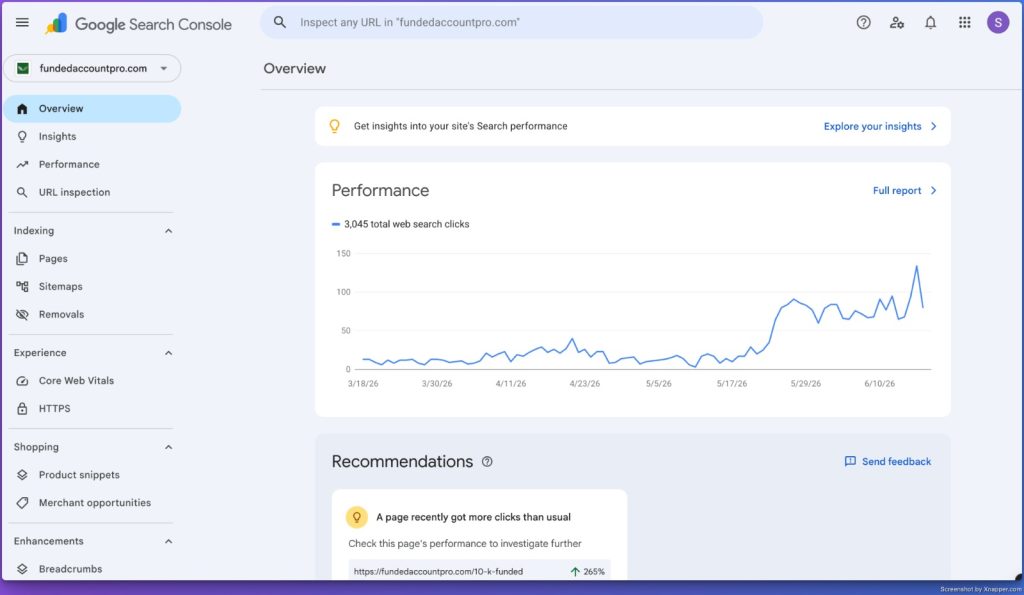
A topical map is working when Google Search Console shows growing impressions across the full topic set, rankings clustering together instead of spreading randomly, and no measurable overlap between pages competing for the same query, checked against 6 specific signals rather than a single traffic number. A topical map does not fail or succeed based on one article’s performance. It succeeds or fails based on patterns across the whole Core and Outer Section.
1. Impressions grow across the whole topic set, not just one page. Check Google Search Console’s Performance report filtered to the URLs published from the map. Impressions should rise across most of them over 60 to 90 days, not concentrate in a single top-performing article while the rest stay flat.
2. Rankings cluster in a similar position range. Pages within the same Core Section typically settle into a comparable ranking band within a few months of each other, evidence that Google is treating them as part of one connected subject rather than scoring each in isolation.
3. No two pages compete for the same primary query. Search Console’s query report should show each page receiving impressions for a distinct set of terms. Two URLs both ranking, and trading position, for the same query signals a PPR scoring error or a page placed in the wrong section.
4. Outer Section pages generate impressions even without high rankings. An Outer Section article doesn’t need to rank on page 1 to be working. It needs to accumulate impressions and, ideally, some clicks, contributing Historical Data that supports the Core Section over time.
5. Internal link clicks show users moving between related pages. Google Analytics engagement data should show users navigating from Outer Section pages toward Core Section pages, evidence that the internal linking structure is routing authority the way the map intended.
6. New pages in the same Section rank faster than the first ones did. As a Core Section fills out, later additions to that same section typically reach their ranking position faster than the earliest pages did, a direct signal of Cost of Retrieval decreasing as the site’s topical structure becomes clearer to Google.
Checking these 6 signals answers whether the map is working mechanically. It does not answer the individual questions readers still have about scope, tools, and edge cases, which the FAQ section below addresses directly.
Build Your Topical Map with a Koray Framework-Certified Team
Every example, formula, and scoring rule in this guide comes from the same process used to build client topical maps at TopicalMap.Services. If you’re ready to move from theory to a Source Context, Central Entity, and PPR-scored map built for your own site, contact our team to discuss your project, pricing, deliverables, and turnaround times.
Contact Us TodayFrequently Asked Questions
What is a topical map used for?
A topical map is used to decide what content a website must publish, in what order, and how each piece should link to the rest of the site, before any writing begins. It replaces guesswork with a scored, structured plan built from Source Context, Central Entity, and PPR-scored topic selection.
Who created the concept of the topical map in SEO?
The modern topical map framework, including Source Context, Central Entity, Central Search Intent, Core Section, Outer Section, and the PPR method, was developed by semantic SEO expert Koray Tuğberk GÜBÜR. Earlier, looser versions of topic-based content planning existed before this, but this specific terminology and scoring system originates with his work.
Is a topical map the same as a sitemap?
No. A sitemap is a technical file listing every URL on a site for search engine crawling. A topical map is a strategic document that determines which topics should exist in the first place, how they connect to a Central Entity, and which section, Core or Outer, each one belongs to before a URL is ever created.
Can AI tools build a topical map automatically?
AI tools can generate keyword clusters and topic suggestions, typically reaching 60 to 80 percent accuracy against a true topical map. They cannot reliably define Source Context, apply PPR scoring with strategic judgment, or catch cannibalization and intent overlap without human validation, which is why fully automated maps require manual review before publishing.
What happens if a website doesn’t have a topical map?
Without a topical map, pages get published around individual keywords instead of a connected subject. This produces topic gaps competitors can exploit, multiple pages competing for the same query, and content that fails to accumulate Historical Data toward Topical Authority, even when individual articles are well written.
Does a topical map help a site get cited in AI Overviews and ChatGPT?
Yes. AI Overviews, ChatGPT, and Perplexity favor sources with clear entity definitions and low ambiguity, the same qualities a topical map is built to produce through a defined Central Entity and structured Core and Outer Section. A site with scattered, unconnected pages costs more for these systems to interpret and cite correctly.
What’s the difference between a topical map and site architecture?
Site architecture describes how pages are technically organized and linked, categories, folders, and navigation. A topical map determines which topics justify a page’s existence and how those topics relate to a Central Entity, before site architecture decisions get made. Site architecture implements what the topical map defines.
How long does it take to build a topical map?
A topical map for a small site, 30 to 60 topics, typically takes 5 to 10 business days when built manually with PPR scoring and SERP validation. Mid-size and enterprise maps, 100 or more topics, take longer in proportion to the number of candidate topics that require scoring and Source Context review.